My name is Abhijith Prakash, a self-proclaimed computernaut
I'm a Product Engineer at Tata Consultancy Services, working on
TCS ADD Safety, a pharmacovigilance platform. Day to day that means Jenkins
pipelines in Groovy, CloudFormation templates, AWS cost audits, and giving an
enterprise AI agent a memory that survives between sessions using MCP.
Outside work I build my own products end to end. The biggest one is
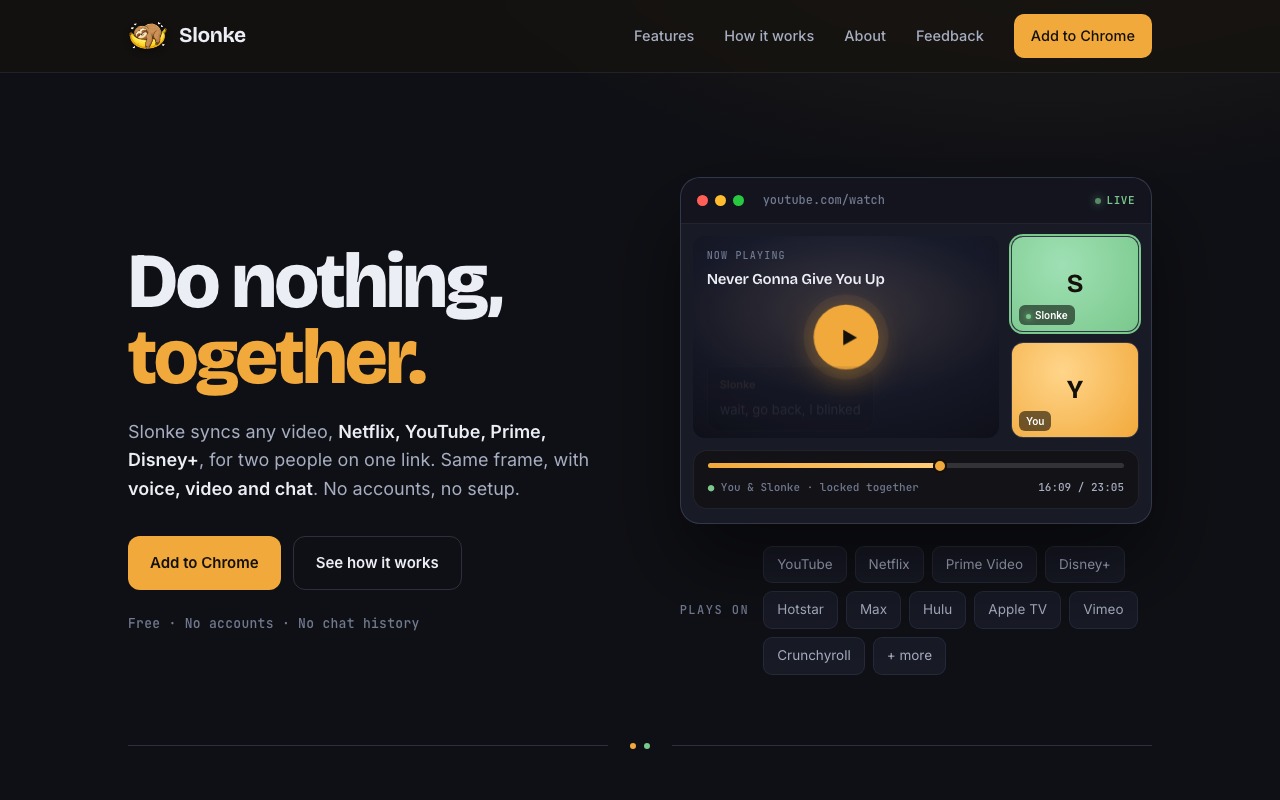
Slonke, a Chrome extension I designed, wrote and deployed solo,
from the sync engine to the WebSocket server to the VM it ran on. I graduated
in Computer Science from Amrita Vishwa Vidyapeetham, Chennai, in 2025.
Build and maintain Jenkins CI/CD pipelines in Groovy for build, test and deploy on AWS.
Author CloudFormation (YAML) templates so dev, test and prod come up identical every time.
Implemented persistent core memory for an enterprise AI agent via the Model Context Protocol.
Audited EC2, S3 and Lambda usage and decommissioned over-provisioned infra to cut monthly spend.
Recent Works
01 Projects I'm proudest of
Featured · Chrome Extension
Slonke
Watch parties for any video site. Start a party on YouTube, Netflix, Prime Video,
Disney+ Hotstar or Vimeo, send one link, and the other person lands on the same
frame. Play, pause, seek and speed stay in sync both ways, with peer-to-peer voice,
video and chat in a drawer that shrinks the page instead of covering it.
Per-site adapters + a MAIN-world bridge for Netflix's player API
WebRTC calls that never touch the server, TURN fallback with short-lived creds
In-chat minigames, private first-party analytics, admin panel with a blog CMS
zzz · hibernating
Slonke is built and still listed on the Chrome Web Store. The servers are taking a
nap while I line up funding to keep them running. It will wake up.
Summary
A black hole is a region of spacetime where gravity is so strong that nothing, not even light,
can escape. Its boundary is the event horizon. Most form when massive stars collapse at the end
of their life.
CancelSummarize
Ctrl + Q
Featured · AI Chrome Extension · Research
Harmonica
A text summarizer that lives inside your browser tab, backed by my published research. Press Ctrl+Q on any page,
paste in an article, and get a short, readable summary without switching tabs. The model behind it
combines BERT with adversarial learning, which keeps summaries coherent and on topic.
A tiny menu bar app that stops macOS from turning Control + left-click into a right-click,
so left clicks stay left clicks in games and apps. System-wide event tap, launch at login,
hideable menu bar icon, shipped as a universal DMG.
A collaborative whiteboard with no backend at all. Strokes travel browser to browser over
WebRTC data channels, with peers introduced through public Nostr relays. Static files,
no accounts, no database, nothing to keep alive.
JavaScript
WebRTC
Trystero
Vite
In progress
DDC
macOS · Swift 6
Lumenary
Display control for macOS that works when the incumbents don't: reliable DDC through docks
and after sleep, optically verified software dimming, presets and sync. Core logic done
across ten milestones with 95 tests green; app wrapper next.
Swift 6
SwiftPM
DDC/CI
XCTest
In progress
AI
LLM Chatbot · Hackathon
PolicyBot
A Gemini 1.5 Flash chatbot that answers health, life, auto and home insurance questions
from real policy documents. FastAPI backend, PyPDF2 knowledge base, multi-turn
conversation memory.
It started with a movie night that couldn't happen. A friend and I wanted to watch something together, and every option out there was either paid, broken, or wanted both of us to sign up for five things first.
So I thought: how hard can it be to build my own? (Very. The answer is very.) A lot of research later I bumped into WebRTC, and it looked like exactly the missing piece.
I didn't trust myself to go straight to the big thing, so I practised first. SilenceSense taught me audio streams and deployment. LiveBoard taught me peer to peer without a server. Slonke is where all of that practice finally went.
My first proper date with WebRTC. While researching how to build Slonke, every road led to this one technology, so before betting a whole product on it I wanted to poke it with a stick.
SilenceSense listens to live audio and tells speech apart from silence. Not glamorous. But it taught me how media streams actually flow, how a frontend and a backend talk in real time, and how to get the thing deployed. Slonke would not exist without it.
Another stop on the road to Slonke. The question this time: can two browsers talk to each other with no server in the middle at all?
Turns out yes, if you let public Nostr relays play matchmaker. Every line you draw goes straight to the other person's screen. Nothing to host, nothing to pay for.
Yes, I play Minecraft on a MacBook. No, it is not a gaming machine. Please don't tell anyone.
The real problem: on a Mac, holding Control turns every left click into a right click. In Minecraft, Control is sprint. So every time I sprinted and tried to hit something, I got a right click instead. Very annoying, mostly for me.
After one accidental right click too many, I wrote a tiny menu bar app that tells macOS to leave my left clicks alone.
This one started as a college project. My faculty suggested the idea, and I said yes before realising what I'd signed up for.
It became the hardest and most challenging project I've ever built. I went in knowing very little about machine learning and came out understanding BERT, adversarial learning, and how to turn all of it into a research paper. That paper got published at IEEE ICTACS 2024.
Hard, yes. But honestly one of the most fun things I've made, and the one I learned the most from.
I bought a new Dell monitor and immediately ran into a Mac problem: the brightness keys on the keyboard do nothing for an external display.
The alternative was reaching behind the monitor, finding the tiny joystick, and clicking through menus. Every. Single. Time.
So I'm teaching the Mac's own brightness keys to talk to the monitor instead. Press the key, the monitor dims. As it should have from day one.
A college project to learn the backtracking algorithm. It places a number, hits a dead end, backs up and tries the next one. Which, now that I think about it, is also how I debug.
It solves puzzles and generates new ones too.
Another college project, this time an experiment with linked lists. I wanted to see if one could run a whole text editor.
It can. Every character is a node, and the cursor is just a pointer walking up and down the list.
TCS Embrace had a client-side bug: open a link and the page would just keep loading, throw errors, and never get there. The link I actually needed was hiding behind that broken load.
So the script stops the page from loading partway through. The hidden link shows up, I click it, done. Small fix, big relief.
Back in the day the TCS NextStep portal didn't let you paste the OTP from your email. You had to retype it by hand, digit by digit.
I wrote a small client-side script that turned pasting back on. They've fixed it properly since, so this one is retired with honours.